Smart FOX Learning Clubs EN

As part of the Smart FOX research project, a total of six Learning Clubs will take place throughout the course of the project. Within these Learning Clubs, project-relevant questions and topics are presented and explained by project partners. The focus is on health science, legal and ethical perspectives, as well as the patient perspective. The aim is to promote exchange within the project consortium, develop the framework conditions for the research project, and provide a platform for discussing ethical, legal, social, and economic issues.

1st Learning Club – Recap

On May 6, 2024, the first Smart FOX Learning Club took place. The objective was to provide an opportunity for discussion within the consortium on the topics covered by the Governance and Community work package in a Q&A setting. The event began with presentations by the Ludwig Boltzmann Institute – Digital Health and Patient Safety and Survivors Austria, offering insights into the planned involvement of patients in the project. Subsequently, Gesundheit Österreich GmbH explored the implications of the European Health Data Space for Smart FOX. As part of the first Learning Club, the UNIVIE team provided insights into data protection law, copyright-related aspects, and the Data Governance Act. Prior to the event, project-related legal questions had been collected, which were then discussed and answered during the session. As an outcome of the event, Legal Briefs were prepared to provide concise information on the relevant legal issues.

2nd Learning Club – Recap

The second Smart FOX Learning Club took place on October 9, 2024. The main focus of this event was on the content of the Data Governance Framework, which was finalized in September 2024. As this is a living document that is continuously being developed and supplemented with new content, the exchange within the consortium is essential for the development of future versions of the Data Governance Framework. First, the results of the discussions on data donation within the patient advisory board were presented by the LBI DHPS. Subsequently, the UNIVIE team addressed the fundamental rights, personality rights, and rights of data subjects in the context of data donation. After presenting and discussing the limitations on the secondary use of ELGA-standardized data, as well as directed and non-directed data donation and the registration as a data altruism organization under the DGA, the GÖG team provided insights into the implications of the EHDS. As a result of the exchange, Legal Briefs were once again developed to provide a concise overview of the relevant legal framework.

3rd Learning Club – Recap

The third Smart FOX Learning Club took place on February 12, 2025. During the workshop, participants focused on the process of (directed) data donation from both the patient and legal perspectives and jointly discussed and developed the relevant framework conditions that need to be considered.

4th Learning Club – Recap

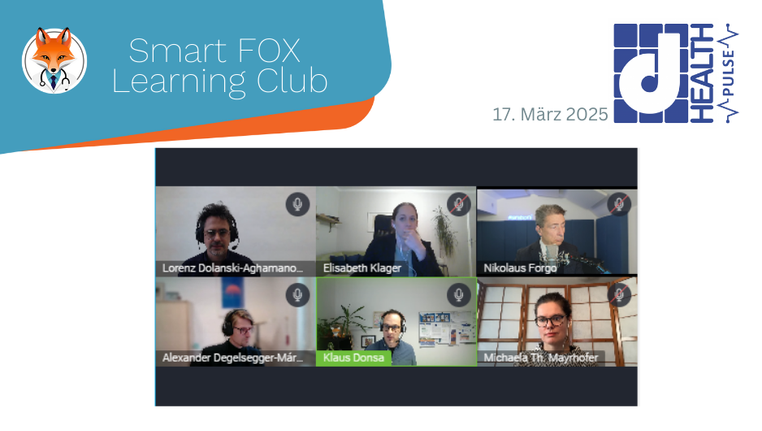
The fourth Smart FOX Learning Club took place on March 17, 2025 as part of the dHealth pulse event series. The session focused on technical and organizational infrastructures as well as the motivations and barriers patients face regarding data donation. The webinar “Innovations for Data-Driven Health Research” was organized by Smart FOX partners AIT and Gesundheit Österreich and provided an in-depth discussion on ethical, legal, and social challenges related to data donation for medical research. The expert speakers included Günter Schreier and Klaus Donsa (AIT), Michaela Th. Mayrhofer (BBMRI-ERIC), Alexander Degelsegger-Márquez (Gesundheit Österreich), Nikolaus Forgó (University of Vienna), and Elisabeth Klager (Austrian Patient Advisory Board). The concluding panel discussion was moderated by Lorenz Dolanski-Aghamanoukjan (Gesundheit Österreich). The webinar was complemented by a keynote presentation by Ms. Mayrhofer, who provided insights into the “BBMRI-ERIC Biobanks” – a European research infrastructure that connects biobanks across Europe and improves the efficiency of biomedical research through structured and regulated data exchange. These are a specific legal entity designed to facilitate the establishment of research projects of European interest. The founding process involves joint funding and the definition of a clear research objective. Currently, there are 30 ERICs in Europe operating in various research fields. One of the central questions addressed during the webinar was how people can be motivated to donate their health data and which barriers may prevent them from doing so. According to the speakers, participants primarily contribute out of solidarity with other patients and the desire to support medical research. Especially in the field of rare diseases, the altruistic hope of enabling other affected individuals to gain better access to therapies and research results through their own data plays a key role. The wish to improve the healthcare system in the long term and contribute to personal health also represents an important motivation. According to the speakers, legal uncertainties and questions regarding how personal health data may be used and shared are among the most common challenges. In this context, the recently published EHDS Regulation (European Health Data Space) was discussed. The regulation aims to connect health data and promote data exchange across national borders. Against this background, the speakers agreed that comprehensive and detailed information about the types of data collected and their intended use is essential. The clearer the communication, the greater the willingness to participate.

5th Learning Club – Recap

As part of the fifth Smart FOX Learning Club Q&A on June 4, 2025, legal questions related to the use of health data were discussed. The data donation process investigated within the Smart FOX research project is intended to be based on the explicit, voluntary, and informed consent of participants. A central research topic in this context is the so-called “Broad Consent”, which is anchored in the Research Organization Act (FOG) and could enable consent to be given for multiple medical studies at once. Another key topic of the discussion was the handling of so-called “Incidental Findings” – i.e., unexpected findings or discoveries made during the course of medical studies. Within the EU-wide EHDS Regulation, these findings (referred to as “significant findings”) are situated within the tension between the obligation to provide relevant information and the requirement for the greatest possible degree of anonymization. In contrast, Smart FOX focuses on the pseudonymization of health data, enabling traceability while maintaining data security and data quality. This approach would, in principle, allow for the re-contacting of data donors regarding potential “Incidental Findings”.

6th Learning Club – Recap

The development of a commercialization strategy is an important component of the Smart FOX project. The project partner EIT Health has developed initial approaches exploring how research results can be transformed into application-oriented, socially beneficial, and economically sustainable solutions. These approaches include market analyses, the identification of relevant target groups, as well as considerations regarding exploitation, positioning, and potential entry pathways into existing health data ecosystems. The workshop Smart FOX Learning Club 6 “Data Donation and Business Models” on November 10, 2025 served to further develop and deepen these preparatory activities. Together, participants discussed which market segments and partner groups could be relevant for Smart FOX in the future, how trust in data donation processes can be strengthened, and which requirements regarding sustainability, transparency, and scalability need to be considered. In addition, two possible development scenarios for the Smart FOX ecosystem were presented: Development Phase: An early stage of development with a limited number of active FOX BOXes. The focus is on establishing structured and legally compliant access to health data, enabling initial research projects and creating the technical and organizational foundations for a functioning data ecosystem. Maturity Phase: An advanced stage characterized by high data availability and broad participation of various stakeholders. At this stage, extensive datasets, efficient processes, and improved recruitment and analysis procedures enable significantly greater benefits for research, healthcare provision, and data donors.


Anmeldung zum Newsletter

Registrieren Sie sich für den Smart FOX Newsletter und bleiben Sie immer auf dem aktuellsten Stand über die Aktivitäten rund um das Projekt und die neuesten Entwicklungen aus den einzelnen Arbeitspaketen.